
Which Provider Will Dominate AI in 2026? The Race Is On—And the Answer Is More Important Than You Might Think
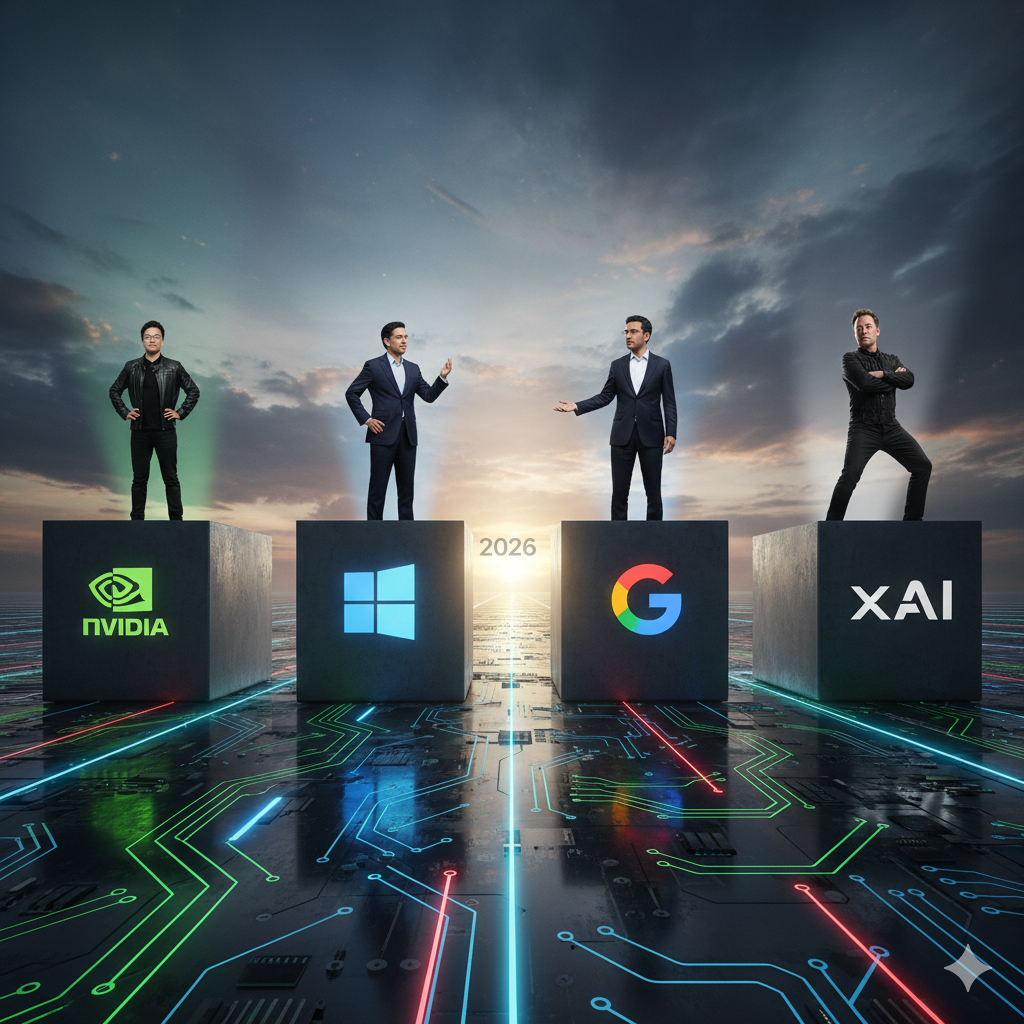
The starting gun has fired. NVIDIA. Microsoft. Google. xAI. The podiums are set... but the finish line belongs to the one with unbreakable execution.
The AI revolution has reached an inflection point in 2026. What began as experimental pilots has become mission-critical infrastructure—embedded in customer-facing products, internal decision-making, operational workflows, and strategic planning. Organizations that get their AI platform choice right will accelerate ahead; those that get it wrong will face years of technical debt, lost productivity, and competitive disadvantage.
Selecting the right AI system is not merely a technical or IT decision—it is a strategic platform decision with profound, long-term consequences. Once an organization commits to a primary AI platform (OpenAI, Google Vertex AI, Anthropic Claude, Microsoft Azure AI/Copilot, AWS Bedrock, or even NVIDIA's full-stack ecosystem), switching becomes extraordinarily difficult and expensive due to deep vendor lock-in: custom integrations, fine-tuned models, proprietary embeddings and vector stores, team skills built around vendor-specific tools, contractual commitments, data migration challenges, and the sheer operational disruption of ripping out a deeply embedded system. Many enterprises now treat the AI platform choice like they once treated core ERP systems or primary cloud providers—a 7–10+ year bet that is hard to reverse without massive cost and risk.
Because the stakes are so high and the reversibility so low, decision rights for the primary AI platform must reside at the highest levels of the organization—typically the C-suite (CEO, CIO, CDO, or CTO) and the board—not delegated to mid-level IT managers or individual business units. A fragmented, bottom-up selection process often leads to incompatible silos, duplicated spend, and eventual forced consolidation at great pain. The platform choice shapes the entire AI posture of the enterprise for the foreseeable future.
Yet even as organizations grapple with this irreversible decision, the broader question remains: Who will dominate the AI landscape itself in 2026 and beyond? The answer may not be the company with the most impressive demo or the highest valuation—it will be the one whose leadership has built a culture of unbreakable, graceful execution capable of perfecting today's operations while relentlessly innovating for tomorrow.
Among the front-runners—NVIDIA, Microsoft, and Google (Alphabet)—the three are separated far less by raw resources than by leadership quality. While compute, data, talent, and capital remain essential inputs, they are increasingly commoditized, replicable, or purchasable at scale in 2026. What truly differentiates winners is how effectively their leaders convert those inputs into sustained execution, cultural resilience, strategic clarity, and adaptive innovation.
Leadership is the single most critical variable for long-term dominance. In the current AI landscape, technology and resources are no longer the primary constraints—institutional and leadership capacity are. As AI capability accelerates faster than organizations can absorb it, the limiting factor shifts from "can we build it?" to "can we govern, deploy, and scale it responsibly while continuously adapting?" Leaders who personally own execution (per The CDX Method's Leadership element), deliberately shape fear-free cultures (Culture), perfect today's stable processes (Core Execution), and accelerate tomorrow's breakthroughs (Dynamic Execution) create organizations that thrive amid uncertainty.
This is not theory—it's reflected in real-world outcomes:
Jensen Huang (NVIDIA) has turned a GPU company into the indispensable AI infrastructure platform through relentless hands-on duty, intellectual honesty, humility in admitting setbacks, and a culture that balances rock-solid core delivery with dynamic expansion into models, robotics, and physical AI. His leadership has created unbreakable ecosystem lock-in.
Satya Nadella (Microsoft) personally drove one of the most profound cultural resets in tech history—from a "know-it-all" to "learn-it-all" mindset—eliminating fear, building empathy/trust, and aligning core (Azure/Office reliability) with dynamic (Copilot/MAI models) execution. This transformation turned Microsoft from laggard to enterprise AI powerhouse.
Sundar Pichai (with Demis Hassabis and Sergey Brin at Google) has executed a deliberate pivot to AI primacy, merging teams, reviving "Day 1" agility, and fostering collaborative humility. Their leadership balances Google's unmatched core infrastructure/data with dynamic frontier research.
These leaders exemplify The CDX Method in action: they do not delegate cultural or execution transformation; they personally reinforce it daily, creating resilience against disruption.
Why the other variables are not as significant (in relative terms) While compute, data, talent, and capital are massive enablers, they are no longer decisive differentiators among the front-runners in 2026:
Compute: Once the ultimate moat, compute is now abundant (though power-constrained) and increasingly democratized. NVIDIA dominates hardware, but Microsoft, Google, Amazon, and even sovereign players can access enough via partnerships, custom silicon, or cloud. The real question is not "who has the most GPUs?" but "who can orchestrate and govern them most effectively?"—a leadership problem.
Data: Proprietary data advantages (e.g., Google's ecosystem, X for xAI) are real but diminishing. Synthetic data, retrieval-augmented generation (RAG), and open datasets have reduced raw data scarcity. High-quality curated/synthetic data is now more important than sheer volume, and leadership determines how well organizations curate, govern, and activate it.
Talent: The war for AI researchers and engineers is fierce, but top talent follows visionary leadership and strong cultures. NVIDIA, Microsoft, and Google attract elite teams because of their leaders' track records of execution and cultural strength—not just high salaries. Poor leadership causes churn (seen in some frontier labs); great leadership retains and multiplies talent.
Capital: All front-runners have effectively unlimited access—NVIDIA via explosive revenue, Microsoft/Google via cash flows, frontier labs via massive VC rounds. Capital is table stakes; what matters is how leaders deploy it (prioritizing the right bets, avoiding waste, measuring ROI)—again, a leadership capability.
In short, compute/data/talent/capital are inputs that can be bought or built. Leadership is the multiplier that turns those inputs into differentiated, resilient execution at scale. As AI outpaces organizational capacity in 2026, the companies that win will be those whose leaders personally drive The CDX Method-style transformation—turning potential into sustained dominance.
To evaluate this, I applied The CDX Method (Core Dynamic Execution), the comprehensive leadership framework I developed to transform organizations into tenacious execution machines. The CDX Method organizes essential actions into four fundamental elements:
Leadership — Personal duty to own and demand execution culture (no delegation allowed).
Culture — Deliberate design through tenacity, corporate sociology (social forces like respect, trust, situational intimacy, humility), and an enduring employer brand that emotionally engages employees forever.
Core Execution — Robust, consistent processes for today's value creation (incessantly improve core processes, minimize variability, measure everything, perfect the five universal characteristics for resilient consistency).
Dynamic Execution — Agile improvement for the future (implement the Seven Principles of Dynamic Execution and engage the five Dynamic Core Processes: robustness, acceleration, critical variables, ideation, and creation via predictive or adaptive approaches).
The CDX Method integrates these elements into a cohesive system, with strategies in resilience to defend against ongoing cultural challenges and "barbarians" that threaten execution strength.
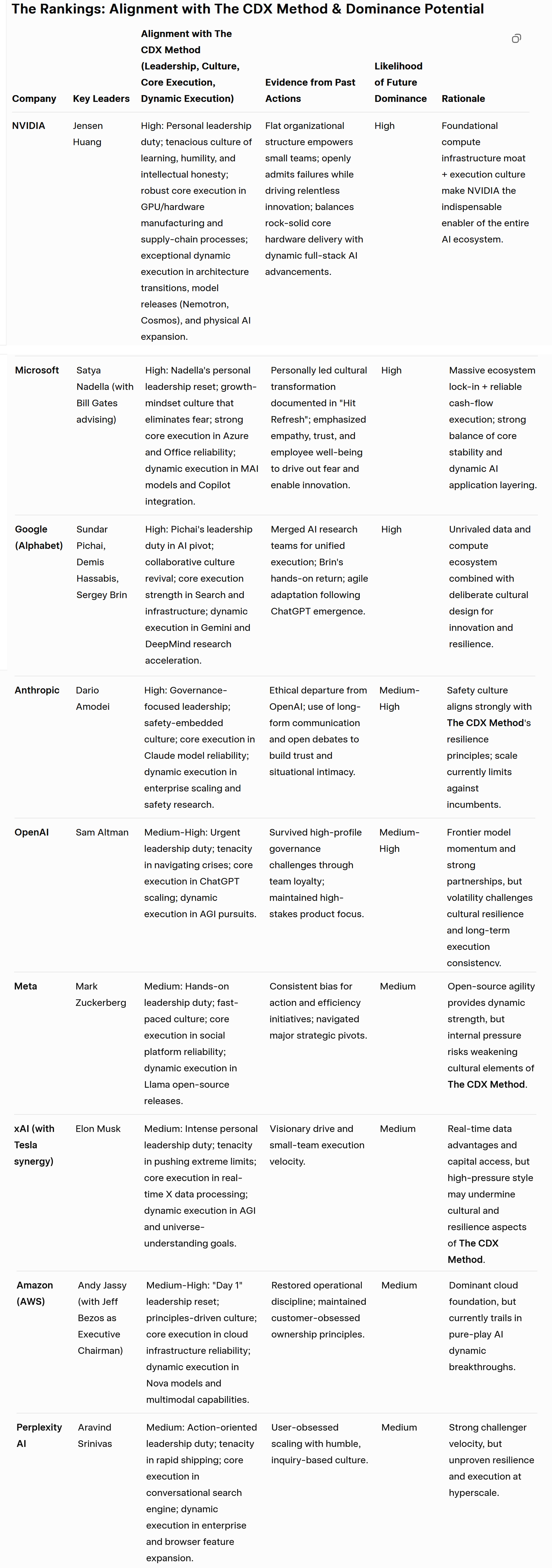
Here is my ranking of the top AI contenders, based on publicly available information, company trajectories, and how their leaders have demonstrated alignment with The CDX Method.
Social Forces Applied at Key Social Nodes Create the Culture Most Leaders Dream Of
What The CDX Method Reveals
Leaders who personally demand execution (Leadership), deliberately design fear-free, emotionally engaged cultures (Culture), perfect today's processes for unbreakable stability (Core Execution), and methodically accelerate tomorrow's opportunities (Dynamic Execution) build organizations that thrive amid chaos. NVIDIA's Jensen Huang stands out: His hands-on leadership duty, humble learning culture, robust core hardware and supply-chain processes, and dynamic acceleration into full-stack AI (models, robotics, physical intelligence) create unbreakable resilience and ecosystem dominance.
Why NVIDIA Is Far More Than a Hardware Supplier
A common misconception is that NVIDIA is "just" a chipmaker—selling GPUs to AI labs and hyperscalers. In reality, NVIDIA has aggressively evolved into a full-stack AI company. Beyond hardware, it develops and releases its own foundation models (Nemotron series for reasoning and enterprise tasks, Cosmos for physical-world simulation, Alpamayo for autonomous vehicles, Isaac GR00T for robotics), delivers them as optimized NIM microservices for easy deployment, and builds end-to-end platforms for physical and agentic AI. CUDA is not merely a driver—it's a massive developer ecosystem that locks in software workflows, while NVIDIA's Omniverse and Isaac platforms enable simulation, synthetic data generation, and real-world robotics deployment. This vertical integration means NVIDIA is not only supplying the picks and shovels of the AI gold rush—it is actively mining gold itself, shaping the direction of physical intelligence and embodied AI. The hardware is the foundation, but the software, models, and application layers make NVIDIA a comprehensive AI leader.
The Verdict: NVIDIA Emerges as the Clear Frontrunner
After evaluating the complete framework of The CDX Method—leadership ownership, cultural tenacity, core execution stability, dynamic execution agility, and long-term resilience—NVIDIA is the most likely to dominate AI in 2026 and beyond. Jensen Huang's execution culture has forged an ecosystem where NVIDIA powers nearly all frontier training and inference, locks in developers via the CUDA platform, and expands aggressively into physical and agentic AI. While Microsoft and Google excel in applications, distribution, and ecosystem integration, they remain fundamentally dependent on NVIDIA's infrastructure. In the intelligence age, the company that masters both compute and execution wins—and NVIDIA does both with The CDX Method-level precision.
A Personal Proviso on Elon Musk and Sam Altman
One important caveat: Elon Musk and xAI remain a genuine wild card in this landscape. Musk has repeatedly demonstrated an almost uncanny ability to succeed against long odds—whether at Tesla, SpaceX, or in earlier ventures. His public image is frequently skewed by media polarization, making it difficult to accurately judge how well he aligns with the necessary social forces of The CDX Method (respect, trust, situational intimacy, humility). From my own limited personal experience, I have been in the same room with him twice and heard him speak (though I did not speak with him directly), and I was genuinely impressed by his humility in those moments—far more than the caricature often portrayed. And he demonstrated absolute loyalty to people in the room who had helped him in the past, but had limited future value. I was beyond impressed. By contrast, I have a much worse personal impression of Sam Altman, which makes me more cautious about OpenAI's long-term cultural resilience despite its current momentum.
This means Musk/xAI could very well emerge as the dark horse candidate if he manages to channel that same humility and execution drive into a cohesive, resilient culture at xAI. Leadership surprises are still possible.
Important Reminder: This is an opinion-based analysis applying The CDX Method to publicly available information about AI companies and their leaders. It is not investment advice, financial guidance, or a recommendation to buy, sell, or hold any securities. The AI sector is extremely volatile and subject to rapid, unpredictable change. The world can change dramatically in ways we cannot foresee: a geopolitical conflict could disrupt Taiwan's semiconductor supply chain (where most advanced chips are manufactured), a new technical breakthrough could emerge from an unexpected source, regulatory shifts could reshape the landscape overnight, or macroeconomic shocks could alter capital availability and investment priorities. Markets are forward-looking and often price in expectations well in advance—if NVIDIA's likely leadership position is already heavily reflected in its current valuation (as many analysts argue), even a minor stumble in execution, competition, or external shock could lead to significant downside risk. Past performance is no guarantee of future results.
This is exactly why The CDX Method postulates that an Execution Culture is far more important than strategy. Our guesses about the future are almost always wrong—strategies will always have to be adjusted, often radically. Those organizations with the strongest execution culture adjust the fastest and most effectively when the inevitable surprises arrive. Always conduct your own thorough research and consult qualified financial professionals before making any investment decisions.
What do you think—does NVIDIA's execution edge feel decisive, or could Musk prove to be the dark horse?
#AI #Leadership #Execution #TheCDXMethod #FutureOfWork
Peter Dmytro Geleta | Creator of The CDX Method® (Core Dynamic Execution) | TheCDXMethod.com | @DmytroGeleta on X