
One Year After DeepSeek's 'Sputnik Moment': How The CDX Method Helps Leaders Avoid the Innovator's Dilemma
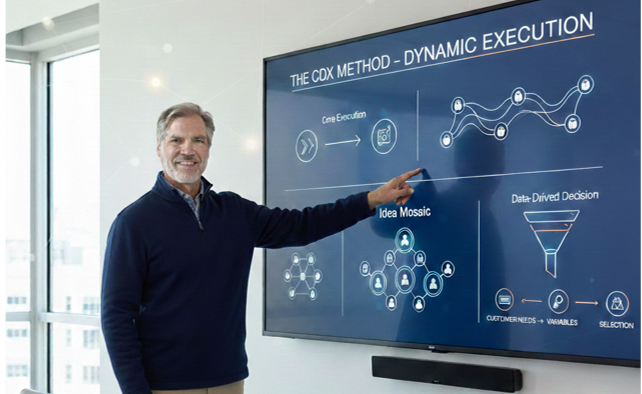
Presenting The CDX Method's Dynamic Execution framework—separating today's Core Execution from tomorrow's breakthroughs.
One year ago, a Chinese AI startup named DeepSeek released its DeepSeek-R1 reasoning model, igniting what many called AI's "Sputnik moment."
The open-source model delivered reasoning performance rivaling OpenAI's o1, but at dramatically lower cost (~$6 million in compute, often using restricted Nvidia H800 chips) and with full weights under an MIT license. Within days, the DeepSeek chatbot app topped U.S. iOS free charts, briefly outpacing ChatGPT. Markets reacted sharply: Nvidia's stock plunged, erasing hundreds of billions in market cap in a flash, as investors grappled with the idea that frontier AI no longer required endless scale and unrestricted hardware access.
The Internet erupted with analysis. Posts highlighted the release as a "game-changer" and "seismic shift," with discussions around its efficiency, open-source implications, and geopolitical ripples. Many echoed Marc Andreessen's framing of it as "AI's Sputnik moment," drawing parallels to the Soviet satellite that shocked the U.S. into the Space Race.
This anniversary prompts reflection on a recurring pattern in tech: incumbents often miss disruptive leaps precisely because of their dominance. In the 1990s, Silicon Graphics (SGI) ruled high-end 3D graphics but failed to pivot toward consumer parallel processing—the exact path that saved Nvidia from near-bankruptcy and birthed the modern GPU. Jensen Huang has recounted this on platforms like the Joe Rogan Experience (e.g., episode #2422, where he details the company's early struggles, tech pivots, and survival bets), emphasizing first-principles reinvention under extreme constraints.
Similarly, in 2025, U.S. AI leaders bet on massive scale and brute-force compute, while DeepSeek—hampered by export controls—combined advanced Mixture-of-Experts (MoE) architectures with pure reinforcement learning (RL) to unlock comparable reasoning. The result? A profound demonstration that clever engineering can close gaps faster than sheer resources.
Why do leaders miss these signals? Complacency from abundance, legacy investments, high-margin focus on sustaining innovations, and intuition-driven decisions over rigorous exploration. DeepSeek, like early Nvidia, transformed necessity into breakthrough.
Frameworks like The CDX Method (Core Dynamic Execution) offer a structured antidote. By deliberately separating Core Execution (optimizing today's operations) from Dynamic Execution (inventing the future), The CDX Method prevents sustaining work from crowding out exploration. Its Ideation Dynamic Core Process (detailed in Chapter 17) is particularly actionable:
Drive Idea Generation Velocity: Mandate organization-wide questioning ("Why this way? Is there a better path?") to generate high volumes of ideas at every level—not just executive brainstorming. This counters inertia and fosters constraint-driven creativity.
Build & Nurture Competing Idea Mosaics: Treat ideas as interconnected webs, proactively challenging barriers and re-ideating solutions for collective support. This fights premature idea-killing in risk-averse cultures.
Clear Cognitive Fog with Data: Replace gut-feel with predictive variables rooted in customer needs, critical features, metrics, state-of-the-art analysis, modeling, prototypes, variability/sensitivity checks, and robust business cases. For irreversible decisions (e.g., architectural platforms), require expert rigor; for reversible ones, enable fast-track pilots.
Anchor in Customer Reality: Begin every ideation with segmented, prioritized needs—external market or internal downstream—to keep efforts grounded.
If SGI or 2025's AI giants had institutionalized such a process, they might have explored consumer GPUs or compute-efficient reasoning earlier, turning potential threats into internal advantages.
As DeepSeek continues advancing (e.g., early 2026 research on Manifold-Constrained Hyper-Connections for even better scaling), the takeaway is empowering: the next breakthrough could originate inside your organization—if you build routines for Dynamic Execution.
What practices or frameworks help your team anticipate and embrace disruption? I'd love to learn from your experiences.
#AI #Innovation #Leadership #DeepSeek #ArtificialIntelligence #TechStrategy #TheCDXMethod #AIDisruption