
DeepSeek’s Geopolitical Surge: How Chinese Open AI is Winning the Global South – And What It Means for Your Platform Decision
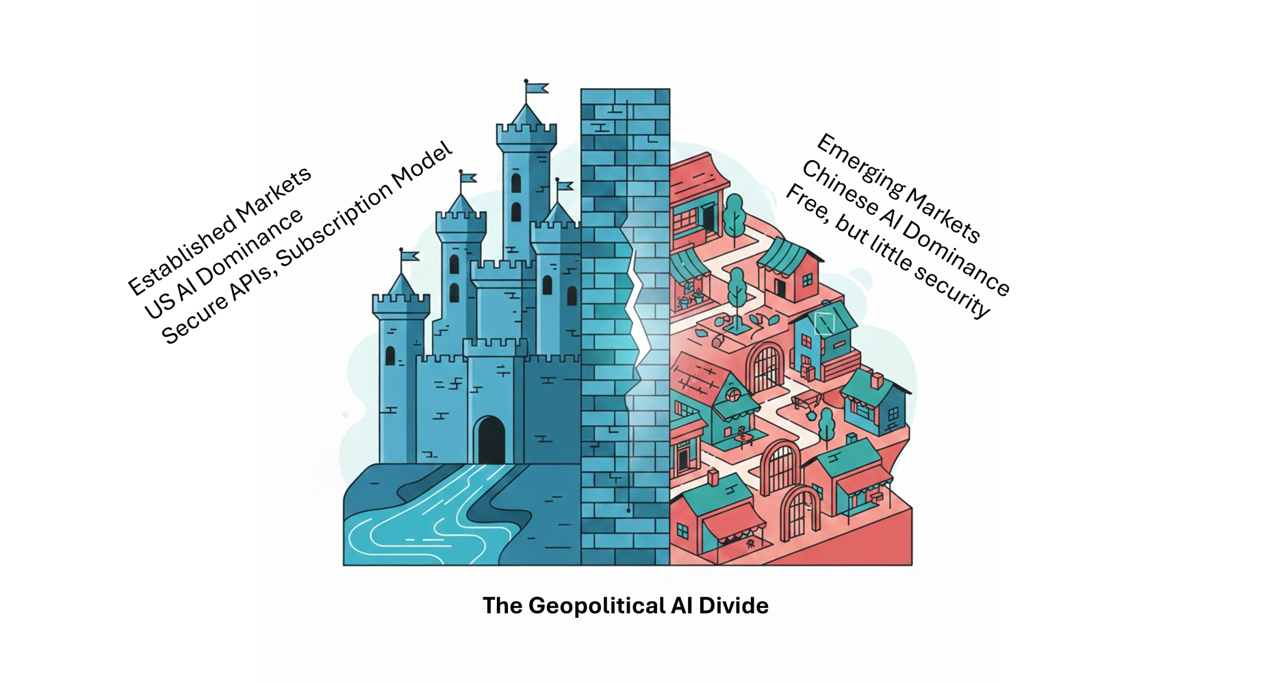
The Great AI Geopolitical Divide
Executive Summary: This follow-up to myearlier series examines DeepSeek and the broader wave of Chinese AI firms as potential disruptors in the high-stakes AI platform decision. Readers will learn:
How DeepSeek’s 2025 “Sputnik moment” catalyzed a rapid, open-weight surge across Chinese labs (Moonshot, MiniMax, Z.ai, Qwen, etc.).
Why DeepSeek is achieving outsized adoption in emerging/developing markets (especially Africa and the Global South), with real numbers from Microsoft’s January 2026 AI Diffusion Report.
How several analysts now describe this penetration as a geopolitical instrument extending Chinese influence through affordable, barrier-free AI.
The long-standing security concerns that continue to limit Western enterprise adoption of Chinese AI APIs.
Practical implications for your own primary AI platform choice in 2026—balancing Western governance/security advantages against open Chinese efficiency and accessibility—and how The CDX Method helps leaders navigate this fragmented landscape with reversible testing and adaptive execution.
Details:
In January 2026, I published my initial series on the evolving AI landscape, stressing that selecting your primary AI platform is a high-stakes, largely irreversible strategic decision—one that embeds vendor lock-in through integrations, fine-tuned models, team expertise, data pipelines, and operational workflows for 7–10+ years. I ranked NVIDIA as the frontrunner under Jensen Huang's execution leadership, highlighted Microsoft's cultural transformation under Satya Nadella and Google's pivot under Sundar Pichai, flagged Elon Musk/xAI as a potential dark horse (especially with the Macrohard initiative targeting Microsoft's core), and noted that execution culture (via The CDX Method) trumps strategy when surprises hit.
I promised to investigate emerging challengers, particularly DeepSeek and other Chinese AI firms, as they could reshape platform options—especially in cost-sensitive or restricted contexts. Here’s what the research reveals.
DeepSeek's Lasting Impact and the Chinese Surge
DeepSeek's R1 (January 2025) was indeed AI's "Sputnik moment": open-source reasoning rivaling OpenAI's o1 at ~$6M compute cost on restricted hardware, with full MIT weights. It democratized frontier capabilities, briefly topping U.S. app charts and triggering Nvidia's sharp stock dip.
By early 2026, DeepSeek remains influential but no longer unchallenged in China:
Rivals like Moonshot (Kimi), MiniMax, Z.ai/GLM and Alibaba's Qwen have released even stronger open-weight models.
Chinese labs iterate rapidly with massive data scales (e.g., Qwen's 50T+ tokens), efficient MoE architectures, and RL innovations—creating an "ominous" wave of high-quality open tech.
This perspective is reinforced in the recent Lex Fridman Podcast episode #490 ("State of AI in 2026: LLMs, Coding, Scaling Laws, China, Agents, GPUs, AGI" – released early February 2026, with guests Nathan Lambert and Sebastian Raschka). The discussion credits DeepSeek's 2025 release as the catalyst for China's open-weight surge, notes the ecosystem's rapid diversification and scale, and highlights how Chinese firms are pushing boundaries in open models while Western players focus on closed, proprietary paths.
DeepSeek's Breakthrough in Emerging/Developing Markets
Microsoft's AI Diffusion Report (H2 2025 data, released January 2026) shows DeepSeek accelerating adoption where Western tools lag:
Dominant in China (89% share), Russia, Iran, Cuba (49%), Belarus (56%).
In Africa: 2–4× higher usage than other regions, with 11–14% market share in countries like Ethiopia, Zimbabwe, Uganda, and Niger.
Key enablers: Free chatbot, open weights, no payment barriers, Huawei pre-installs/partnerships, and telecom bundles—removing financial/technical hurdles in price-sensitive or restricted areas.
This helps narrow the global AI divide: Worldwide genAI adoption hit ~16.3% in late 2025, but the Global North grew nearly twice as fast as the South. DeepSeek is enabling the "next billion" users in the Global South.
LinkedIn discussions in January–February 2026 amplified this narrative, with several framing DeepSeek's rapid penetration as a geopolitical instrument extending Chinese soft power through affordable, accessible AI in underserved regions:
Rafiq Raji: "DeepSeek's Surge in Africa Reveals China's AI Power Grab" – https://www.linkedin.com/posts/rafiqraji_deepseeks-surge-in-africa-reveals-china-activity-7387020349143461888-Qyc7
Pamela Cheong: "DeepSeek in Emerging Markets: AI Independence or Digital Dependency?" – https://www.linkedin.com/posts/pamela-cheong_fxiwc_deepseek-emerging-markets-ai-independence-digital-activity-7390123456789012480-abcD
Madumetja M.: Shares on DeepSeek's traction in developing nations and its role in reshaping global AI access – https://www.linkedin.com/posts/madumetja-m-35268519_deepseeks-ai-gains-traction-in-developing-activity-7415065540857405441-Vdze
Analysts in these threads describe it as a deliberate extension of Chinese influence, leveraging open-source affordability to win hearts, minds, and market share in the Global South—where Western platforms often face cost, access, or regulatory friction.
Security Barriers Limiting Western Adoption
Western enterprises largely avoid paid APIs from Chinese providers (including DeepSeek) due to long-standing security concerns—data privacy risks, potential misuse, and geopolitical tensions. This structural habit blocks enterprise revenue for Chinese firms in the U.S./Europe, pushing them toward open-weight influence instead.
Implications for Your AI Platform Decision
DeepSeek/open Chinese models aren't direct enterprise rivals to NVIDIA/Microsoft/Google in secure Western ecosystems, but they offer compelling alternatives for:
Cost-constrained teams.
Operations in emerging markets.
Open-source flexibility over proprietary moats.
Your primary platform choice still locks in future execution: Western stacks excel in governance/security/enterprise integration, while open Chinese paths enable rapid, low-barrier experimentation.
Leaders applying The CDX Method—personally owning execution, building resilient cultures, perfecting Core processes, and accelerating Dynamic breakthroughs—will best evaluate hybrids, test open options reversibly, and adapt to surprises (e.g., geopolitical shifts or new efficiencies).
What platform are you leaning toward in 2026, and how are you hedging for global realities or security risks? Share your perspective below—I'd value your insights.
#AI #Leadership #Execution #TheCDXMethod #DeepSeek #AIPlatform #BusinessExecution
Peter Dmytro Geleta | Creator of The CDX Method® (Core Dynamic Execution) |