
Stand Tall Gen X! You Crush Boomers at Culture Design.
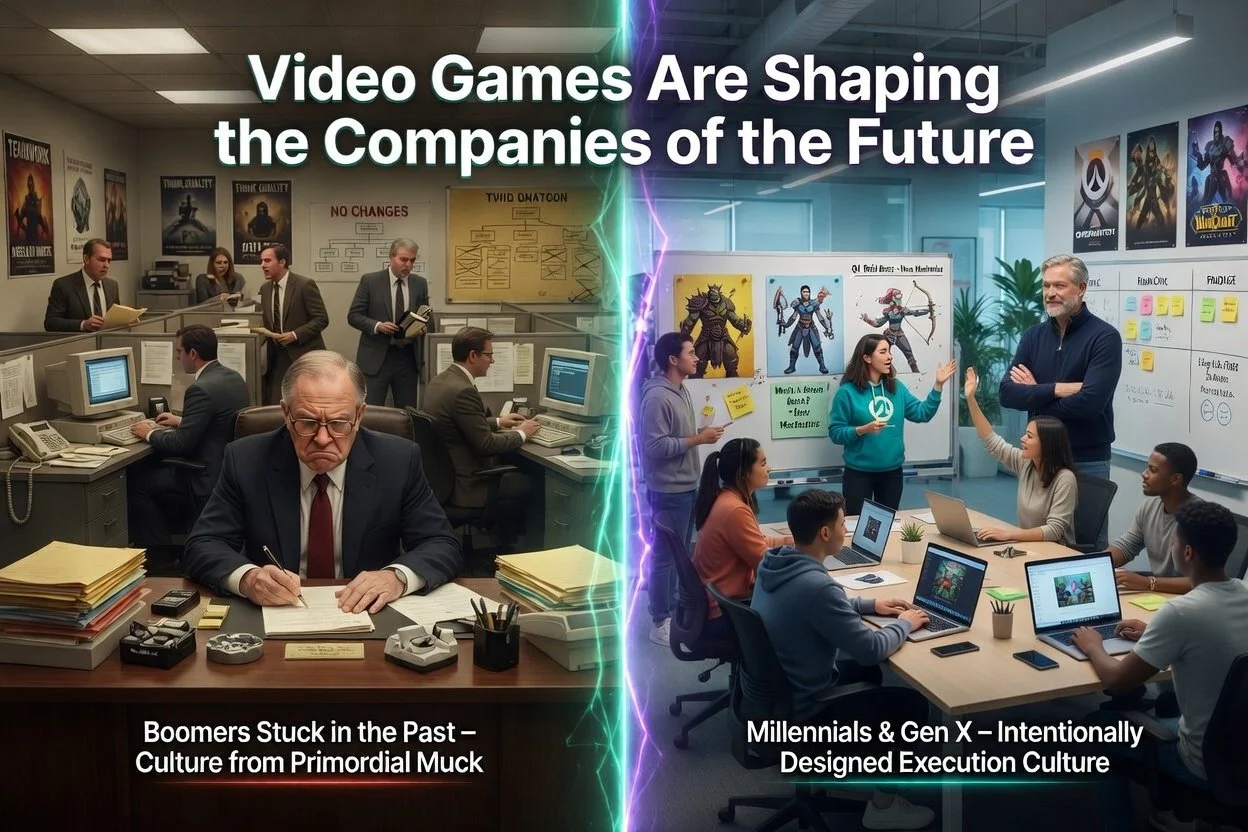
Invest in Millennials and Gen X - They really get the culture stuff.
Video Games Are Shaping the Companies of the Future — And Gen X Is Currently Beating Boomers at Execution (Millennials Will Likely Beat Them Both)
Video games are not just entertainment. They’re becoming one of the clearest proving grounds for modern business execution, teaching rapid iteration, high stakes teamwork, instant feedback loops, and the brutal truth that culture determines survival.
After a career of advising legacy corporations, one pattern stands out clearly: Generation X often executes better than Boomers in today’s environment. And Millennials (with early Gen Z leaders rising) appear poised to outperform us all.
As a Baby Boomer myself, I am proud of this. We made things better, our children will do even more.
The Danger of Letting Culture Emerge Naturally
Too many legacy corporations treat corporate culture as something that simply “happens”, rising organically out of the primordial muck of natural human interaction. Different managers bring different backgrounds, sub-cultures form, conflict becomes the norm, and fear or ego slowly takes root. Without deliberate design, the default is often mediocrity, groupthink, and “survival of the meanest” dynamics.
Protected by massive installed capital barriers (factories, regulatory moats, brand equity, or contracts), these organizations can survive for years without facing immediate consequences. Humility becomes optional. Positional power and management by fear persist because the market doesn’t punish them quickly enough.
How Blizzard Deliberately Designed Its Early Culture
Now look at the video game industry — one of the most cutthroat meritocracies on earth. No capital moat. No regulatory protection. Every title is a public bet judged instantly by millions of unforgiving players. Success or failure comes down to execution speed, creativity, and culture.
This is where Gen X leader Jeff Kaplan (born 1972) helped show what intentional culture design looks like.

Early Blizzard Team Photo
In Lex Fridman Podcast #493, Kaplan described joining Blizzard in May 2002 as a new associate quest designer on World of Warcraft. The company was still small, fewer than 200 people, with a flat, collaborative “Bad News Bears” feel. The office had a dorm room vibe: futons for all-night work sessions, everyone knowing each other, and almost no rigid hierarchy. Programmers, artists, and designers worked side-by-side in the same room.
Kaplan arrived as an opinionated outsider from the EverQuest raiding scene. Early on, he behaved like many new hires do, quickly shooting down others’ ideas because he thought his own were smarter.
A senior designer (Rob Pardo) pulled him aside after one meeting and gave him a direct, humble lesson:
“You’re a very smart designer, but you shouldn’t do what you just did to those people. You should always listen to what people have to say and try to make their ideas work.”
That single intervention, applied intentionally at a key social node, reshaped Kaplan’s leadership philosophy for the rest of his career. He turned it into a core principle: champion others’ ideas and give them the credit when they succeed.
Early Blizzard didn’t allow culture to emerge from natural chaos. They actively designed it through small team collaboration, relentless focus on craft, hiring for passion and values (“one of us” gamer mindset), and timely feedback that reinforced humility. The result? They built two of the most successful and culturally resonant games in history: World of Warcraft and later Overwatch. Incredible financial success!
Boomer style hierarchical, fear driven management rarely survived long in this environment. The feedback from players is too fast and too honest. Humility isn’t a soft virtue here, it’s a hard requirement for sustained execution.
The CDX Method Insight
Execution is not primarily a strategy problem. It is a Corporate Sociology problem.
Great execution requires intentionally designing employee beliefs and behaviors using social forces, especially at supervisor-subordinate and peer social nodes. The foundation is The CDX Triad — Respect + Trust + Situational Intimacy — protected by humility.
Corporate culture is one of the four fundamental pillars of The CDX Method (alongside Leadership, Core Execution, and Dynamic Execution). Leaders who treat culture as deliberate work, rather than something that bubbles up from primordial human tendencies, build organizations that can compete even without capital moats.
Legacy companies can limp along for years by ignoring this. Video game-style environments (and the leaders they produce) expose the weakness almost immediately.
As a Baby Boomer who has seen these dynamics across industries, I’m convinced the winners of the next decade will be those who stop letting culture happen by accident and instead design it with precision and constancy of purpose.
What’s your experience? Have you seen the difference between deliberately designed cultures versus ones left to emerge naturally — especially in fast-moving industries influenced by gaming mindsets? I’d especially love perspectives from Millennial and Gen Z leaders.
Disclaimer: These are my personal views based on my experience helping organizations improve execution. Always consult qualified advisors for your specific situation. The CDX Method is a proprietary framework; Warranties of merchantability or other representations of fitness for a particular purpose are disclaimed. This is not investment, legal, or professional advice. Always conduct your own due diligence.