
I Hate Lean Six Sigma
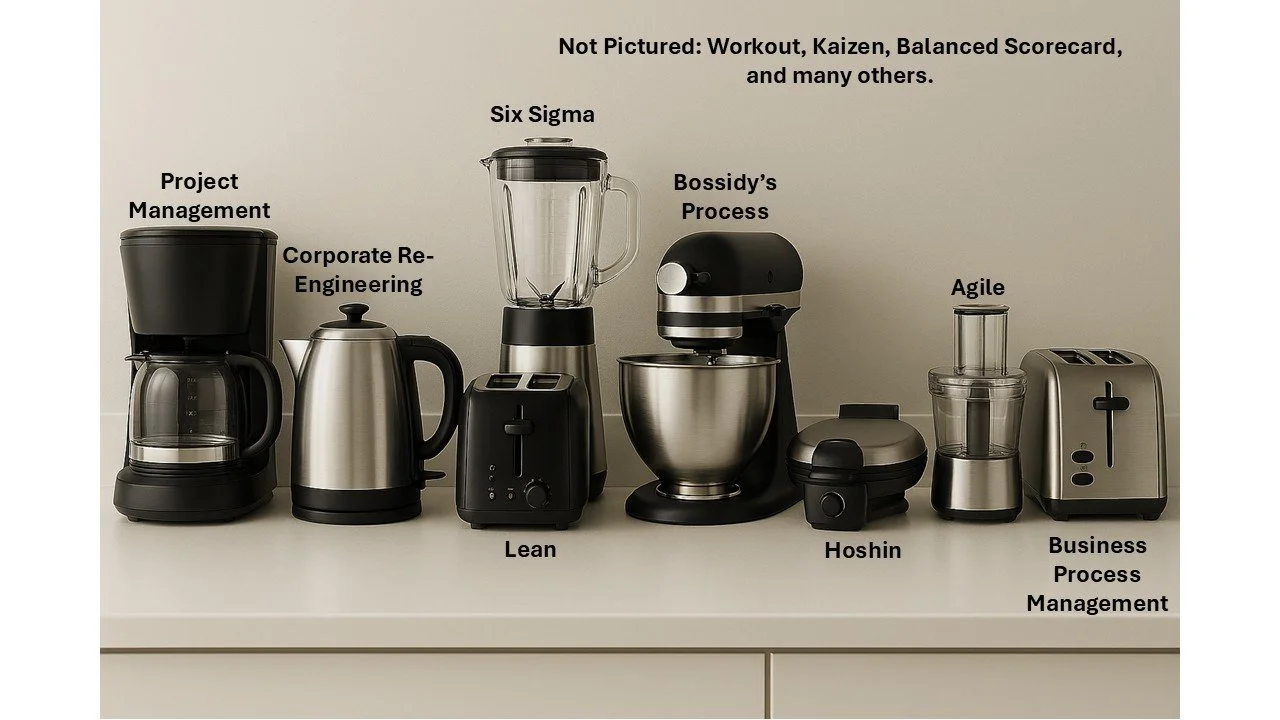
The Many Tools in the Business Execution Kitchen
I love Six Sigma and I love Lean, but I hate the term Lean Six Sigma...here's why.
Imagine someone proudly announcing their new kitchen gadget:
"The Chef's Knife Slow Cooker"
Sounds bizarre, right?
A chef's knife is sharp, fast, precise, and wielded by a skilled hand for quick, artistic, judgment-based work. You use it in the moment, adapting constantly, relying on feel, experience, and flow.
A slow cooker, on the other hand, is about low-and-slow, set-it-and-forget-it, long-duration consistency. It’s passive, standardized, patient, and designed to minimize variation over many hours.
These are two fundamentally different philosophies of cooking — one dynamic and craft-oriented, the other deliberate and variation-reducing.
Gluing them together into one product name doesn’t make you a better cook. It just creates a confusing Frankenstein that satisfies neither purpose particularly well and makes enthusiasts of both approaches roll their eyes.
That’s exactly how I feel about Lean Six Sigma.
The Core Philosophical Clash
Lean (born from the Toyota Production System) is a philosophy and management system at heart. It’s about:
Respect for people
Continuous improvement by everyone
Flow, speed, and the ruthless elimination of waste (muda)
Learning through experimentation and quick countermeasures
Value stream thinking
Adaptability and flexibility
It’s fast, human-centered, visual, and thrives on frontline involvement and rapid cycles of learning.
Six Sigma is a completely different beast. It’s a data-heavy, statistically rigorous, project-based defect-reduction methodology. It focuses on:
Reducing variation to extreme levels (3.4 defects per million opportunities)
DMAIC project structure
Heavy reliance on advanced statistics, control charts, DOE, regression, etc.
Belt system and expert-led improvement (Black Belts driving most of the work)
One is about speed + flow + people + learning. The other is about precision + consistency + statistics + experts.
They attack waste from opposite angles:
Lean says: "Most waste comes from unnecessary steps and poor flow."
Six Sigma says: "Most waste comes from variation and defects."
They’re not enemies — they can complement each other very well in the right context. But mashing their names together into one monolithic brand implies they are the same thing, or that one is just a minor extension of the other.
They are not.
What the Forced Marriage Usually Produces
In practice, the "Lean Six Sigma" label most often results in:
Dominance of Six Sigma structure (DMAIC everywhere, even when a rapid Kaizen would be 10× better)
Over-complication of simple problems with heavy statistics
Belt factories and certification mills
Tool-focused training instead of mindset and philosophy
Loss of Lean's human-centered, respect-for-people essence
People thinking "continuous improvement = long DMAIC projects" (the exact opposite of what Toyota teaches)
It's like using a slow cooker to julienne vegetables — technically possible, but you're missing the whole point of the tool.
A Better Way Forward: The CDX Method
If you want to use both approaches (and many organizations should), just call them what they are:
Use Lean thinking and tools for flow, waste elimination, daily management, kaizen, value stream redesign
Use Six Sigma tools when you truly face chronic variation problems that survive Lean efforts and require deep statistical analysis
Or simply say: "We do process improvement using the best of Lean and Six Sigma thinking and tools — depending on the problem."
But please, spare us the hyphenated buzzword that makes purists from both camps cringe.
That's why I developed The CDX Method® (Core Dynamic Execution) — and wrote the book Develop Business Execution Superpower With The CDX Method: Do More, Better, Faster — to fix this exact fragmentation.
The CDX Method is a universal, cohesive framework that integrates the best elements of Lean, Six Sigma, Agile, and other proven execution systems into one simple, actionable system that embeds directly into your organization's cultural DNA.
It distinguishes between Core Execution (delivering today's commitments reliably and consistently) and Dynamic Execution (shaping tomorrow's success through adaptation, innovation, and change).
No more conflicting methodologies, no more tool silos, no more expert-only improvement. Instead, it empowers leaders and teams at all levels to build tenacious organizations that crush commitments while surging forward — restoring humanity, joy, and real ownership to the workplace.
It moves beyond the limitations of "Lean Six Sigma" by creating a unified execution superpower: do more, better, faster — without the confusion or dilution.
So yes — I hate the term Lean Six Sigma. Not because the combination is impossible or useless. But because the name itself is misleading, dilutes both philosophies, and usually leads to mediocre application of both.
The CDX Method offers a cleaner, more powerful alternative.
#Lean #SixSigma #ContinuousImprovement #ProcessExcellence #OperationalExcellence #ToyotaProductionSystem #TheCDXMethod #BusinessExecution #Leadership