
Do Not Make This AI Implementation Mistake: Emphasize Efficiency and Ignore Effectiveness (Listen to Jensen Huang, He Knows Better)
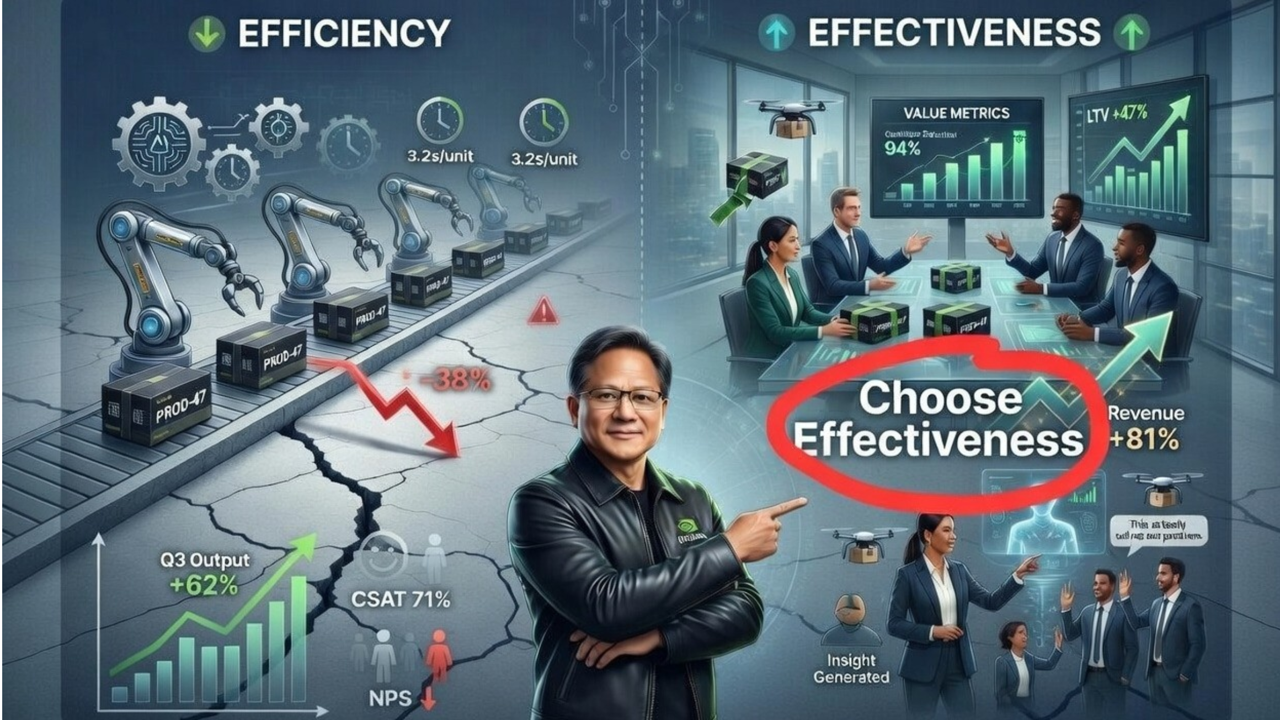
The all-too-common execution mistake: Taking the lazy way and only targeting efficiency. The real money is in effectiveness.
Efficiency is about doing things with less. Fewer resources, less time, lower cost. It’s easy to measure and feels productive immediately.
Effectiveness, on the other hand, is about delivering greater value: better outcomes, higher quality, stronger customer impact, and real growth. It’s harder to quantify, but it’s what creates the most value.
Efficiency cannot be ignored; however, those that ignore Effectiveness...well...the market will eventually ignore them.
Right now, the business world is mired in group think. Managers see generative AI as the ultimate efficiency tool: automate routine tasks, compress costs, slow hiring, and maybe even cut headcount. It’s the same old execution error I have seen over and over: letting efficiency metrics dominate while effectiveness quietly erodes.
I call this the hegemony of efficiency metrics over effectiveness. Financial systems naturally favor cost and productivity numbers because they tie directly to short-term profitability. Effectiveness metrics, those that measure true performance, utility, and customer value, require deliberate cultural effort and leadership commitment. Without them, decisions default to the easiest path: cut costs today, ignore the longer-term damage to quality and growth tomorrow.
This mistake is common because efficiency feels safe and measurable, while effectiveness demands real work to define, track, and balance. But it’s wrong and it quietly destroys value. A cheaper supplier or faster process might look great on a spreadsheet until customer disappointment hits revenue and no one has the data to explain why.
And the greater value is always in finding ways to delight customers; to become more effective in meeting market place needs.
Jensen Huang knows better.
On March 23, 2026, in Lex Fridman Podcast #494 (“Jensen Huang: NVIDIA – The $4 Trillion Company & the AI Revolution”), the NVIDIA CEO directly challenged the fear that AI will eliminate jobs. He used radiology as a powerful example: computer vision went superhuman years ago and now powers nearly every radiology platform. Yet the number of radiologists has grown, and there’s still a shortage, not because the task of reading scans disappeared, but because AI made radiologists far more effective at their true purpose: diagnosing disease and helping patients and doctors. They handle more volume with better insights. Demand increases. Humans become more important, not less.
Huang made the same point about software engineering at NVIDIA: AI changes the tools and tasks, but the number of engineers will grow because the fundamental purpose, problem-solving, innovation, judgment, and teamwork, remains irreplaceably human.
This aligns with what I’ve been seeing with CFOs and what I wrote about recently. AI is already delivering real productivity gains, but the biggest returns come when leaders move beyond pure efficiency plays and focus on effectiveness.
The CDX Method directly counters this trap. It demands that efficiency and effectiveness both be given equal weight when measuring every Core Process performance. No more letting financial metrics crowd out the harder work of quantifying customer value and true outcomes.
→ Read my earlier article: AI Will Not Eliminate People — It Will Make Humans Even More Important
→ And the follow-up with CFO insights: CFOs Confirm: AI Delivers Big Returns — But Only When Leaders Provide the Right Process
The lesson is clear: Don’t follow the crowd into the efficiency only trap. Use AI as a powerful teammate to enhance effectiveness: better decisions, richer customer value, and elevated human work. That’s how you turn AI into a genuine competitive advantage instead of just another cost cutting exercise that eventually backfires.
Leaders who understand the difference between efficiency and effectiveness, and who commit to measuring both, will come out ahead. Everyone else risks repeating the same old mistake, just with faster tools.
If you’re looking for a practical framework to build this kind of disciplined execution culture, one that balances efficiency and effectiveness while harnessing AI, my book Develop Execution Superpower with The CDX Method dives deep into the tools, social forces, and leadership processes that make it happen.
Disclaimer: These are my personal views based on my experience helping organizations improve execution. Always consult qualified advisors for your specific situation. The CDX Method is a proprietary framework; Warranties of merchantability or other representations of fitness for a particular purpose are disclaimed. This is not investment, legal, or professional advice. Always conduct your own due diligence.