
Big Brother or Breakthrough? AI Might Be Analyzing Your Interpersonal Interactions Right Now
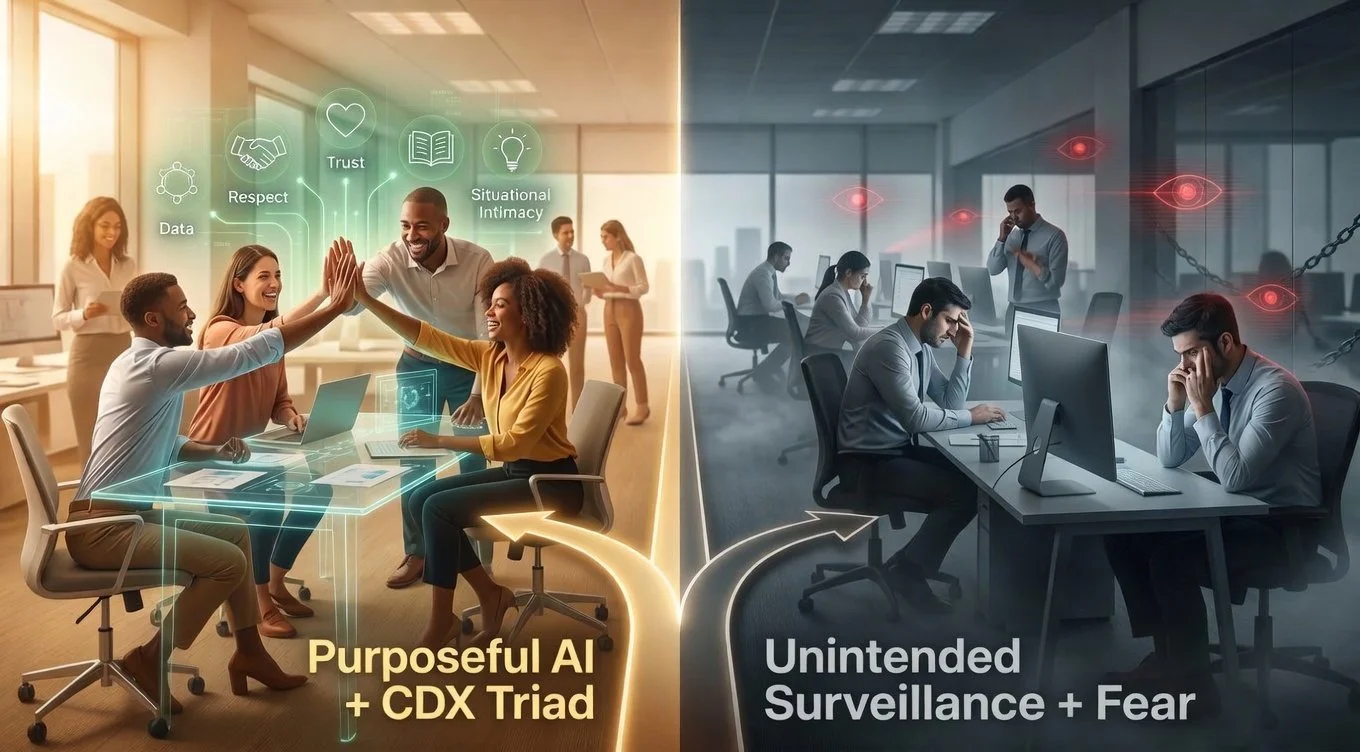
AI culture monitoring: Enlightenment or Big Brother? One path builds trust at scale. The other breeds fear and performance theater. The fork is here.
AI Is Changing How We Implement Corporate Culture – And It Could Make Things Better…or Much Worse
Executive Summary
The shift from episodic, human led culture measurement (annual surveys, interviews) to continuous, bespoke AI-driven monitoring is inevitable and already underway in data rich workplaces.
Bespoke internal AI systems, as described in my earlier article, are able to scan communications and interactions in real time to gauge alignment with desired cultural forces, scaling Corporate Sociology principles from The CDX Method across countless social nodes.
This transformation can dramatically improve an execution culture by providing proactive, actionable insight, or severely damage it by amplifying the single largest cultural impediment: fear, the chronic organizational “inflammation” that paralyzes innovation, buries problems, and breeds groupthink.
AI can worsen fear through perceived surveillance and mistrust (driving stress, self-censorship, and 40–50% gaming rates), or shrink it by surfacing early relational signals so leaders can reinforce The CDX Triad (Respect, Trust, Situational Intimacy) with humane interventions.
Success depends on deliberate implementation: transparency, employee co-creation, ethical/outcome focused design, strong safeguards, and anchoring in The CDX Method’s human centric social forces.
When done right, bespoke AI becomes a powerful ally for building tenacious, joyful, competitively dominant cultures; when mishandled, it risks performative theater and deeper disengagement.
Read the earlier article defining bespoke internal AI here.
Detailed Discussion
Corporate culture forms the bedrock of effective execution and requires deliberate, precise design. The CDX Method teaches that optimizing Corporate Sociology—the intentional application of social forces to create and reinforce desired employee beliefs and behaviors—is essential for leaders who want cultures that drive strategy with tenacity and joy. Yet far too many organizations still cling to the old way: annual engagement surveys, occasional focus groups, exit interviews, or simple intuition. These methods are episodic, retrospective, often biased, and slow to reveal problems—leaving cultural fractures to widen until execution suffers.
Artificial intelligence is now irreversibly changing how we implement and sustain corporate culture—and this applies directly to the bespoke internal AI systems I described in my earlier article. Those custom-built, organization-specific tools that can monitor employee communications, sentiments, and behaviors in real time to gauge alignment with desired cultural forces are no longer futuristic, they are the emerging reality.
The transition from episodic, human-led measurement to continuous, AI-driven monitoring is happening and will definitely happen. In data-saturated, always connected workplaces, these bespoke AI systems scan emails, chats, collaboration platforms, feedback channels, and meeting transcripts to deliver real-time visibility into cultural alignment, emerging silos, morale shifts, and sub-culture tensions. This moves culture implementation from infrequent snapshots and reactive fixes to a persistent, intelligent layer that can detect drift the moment it begins.
This shift is unstoppable. Companies that delay will lose competitive edge: slower cultural course corrections, preventable turnover, and weakened execution in fast moving markets. Forward looking leaders are already adopting bespoke AI as a powerful extension of the deliberate design principles in The CDX Method, scaling the application of social forces across the many social nodes (regular and ad-hoc employee-to-employee and employee-to-manager interactions) that most powerfully shape behavior.
But here is the critical fork in the road: this transformation could make corporate culture dramatically better, or far worse. The bespoke AI approach is inherently more invasive, it reaches deeper into daily communications and infers attitudes, so its impact depends entirely on whether leaders implement it with clear purpose and humanity. Without intentional stewardship, it risks amplifying the single largest cultural impediment identified in The CDX Method: fear.
Fear: The Largest Cultural Impediment – And How AI Can Make It Worse or Better
Fear is the most destructive force any execution culture can face. The CDX Method describes it as chronic inflammation in the organizational body: it causes operational paralysis, buries bad news, silences improvement ideas, locks people into flawed processes to avoid wrath, and breeds groupthink or survival-of-the-meanest behaviors. Rational fears—missing deadlines, capability shortfalls, competitive threats—turn toxic when trust is absent.
Bespoke AI culture monitoring can supercharge this fear. Employees frequently experience it as pervasive surveillance that broadcasts leadership mistrust, leading to heightened stress, self-censorship, and resentment. Research shows up to 81% of workers view such tracking as “inappropriate watching,” creating a chilling effect on candid dialogue. In low-trust environments, it can drive 40–50% of people to game the system, scripting artificial positivity, staging performative engagement, or using technical evasion, producing metrics that look healthy while authentic collaboration, pride-of-work, and innovation wither. This exactly mirrors the fear-driven groupthink and internal warfare The CDX Method warns against.
Yet when deployed with purpose and anchored in the core principles of The CDX Method, bespoke AI can instead shrink fear and convert it into a healthy, actionable signal. The CDX Triad—Respect, Trust, and Situational Intimacy—supplies the relational foundation. AI can surface early signs of eroding respect (low-empathy responses), weakening trust (unaddressed concerns), or insufficient situational intimacy (misaligned expectations), giving supervisors the chance to intervene humanely: offering coaching, clarifying context, or building capability before small issues become big ones. Rational fear becomes a shared prompt for collective improvement rather than individual hiding.
Strategies to Tilt the Outcome Toward Better
To ensure bespoke AI strengthens culture rather than poisons it, leaders must act deliberately:
Lead with Transparency and Humility Explicitly communicate what is monitored (anonymized patterns, never personal spying), how insights are used (developmental support, not automatic punishment), and the tangible benefits to employees (earlier help with burnout, fairer growth paths). Leaders guided by The CDX Method’s emphasis on humility acknowledge AI’s limitations, contextual blind spots, bias risks, and actively solicit team input on refinements, lowering perceptions of control and rebuilding trust.
Involve Employees as Co-Creators Engage teams in system design and pilots, co-defining metrics that tie directly to strategy execution. This extends situational intimacy across social nodes, fosters ownership, and reduces gaming incentives by prioritizing verifiable outcomes over superficial signals.
Prioritize Ethical, Outcome-Focused Design Move away from easily gamed proxies (keyword based positivity) toward harder to fake indicators (cross-functional collaboration, voluntary knowledge sharing). Enforce strong safeguards: anonymization, regular bias audits, human oversight, and firm policies against punitive misuse. The Chief Cultural Officer, otherwise known as the head of HR, should oversee ethical implementation.
Reinforce The CDX Triad and Broader Social Forces Position bespoke AI as an amplifier of the universal execution critical social forces taught in The CDX Method, flagging opportunities to strengthen respect, trust, and situational intimacy organization wide while actively minimizing chronic fear through supportive, relational application.
The Upside: When AI Makes Culture Better
Handled with purpose, bespoke AI delivers powerful advantages:
Continuous, proactive visibility to apply social forces before problems escalate.
Scalable reinforcement of the CDX Triad and humility, curbing groupthink and internal conflict.
Precise capability building: targeted coaching, training, and process improvements that elevate pride-of-work and agility.
More equitable, inclusive environments: pattern analysis to reduce biases and nurture trusting, diverse teams.
Tangible execution gains: faster problem resolution, lower turnover, resilient organizations that consistently deliver “Do More, Better, Faster.”
Culture does not arise spontaneously from natural human interaction; it must be intentionally engineered and continuously improved, exactly as The CDX Method teaches. Bespoke AI, when guided by humility, transparency, and the CDX Triad, becomes a formidable ally in that work: enabling leaders to design and sustain competitively dominant execution cultures at unprecedented scale.
The fork is here. AI is changing how we implement corporate culture right now. It can make it far better...or far worse. The difference lies in whether we pursue this inevitable transition with unwavering purpose and humanity.
What side of the fork are you seeing in your organization? How is fear showing up,or being addressed, as bespoke AI enters the culture conversation? S
#TheCDXMethod #CorporateSociology #ExecutionCulture #Leadership #AIinWorkplace #FutureOfWork
Disclaimer This article is for informational and discussion purposes only. It does not constitute investment, legal, HR, technology, or management advice. Implementing AI systems for culture monitoring involves complex legal, ethical, privacy, data security, and employment-law considerations that vary by jurisdiction and organization. Always consult qualified legal counsel, data-privacy experts, HR professionals, and technology specialists before designing, deploying, or using any such system. No action should be taken based solely on this content.